
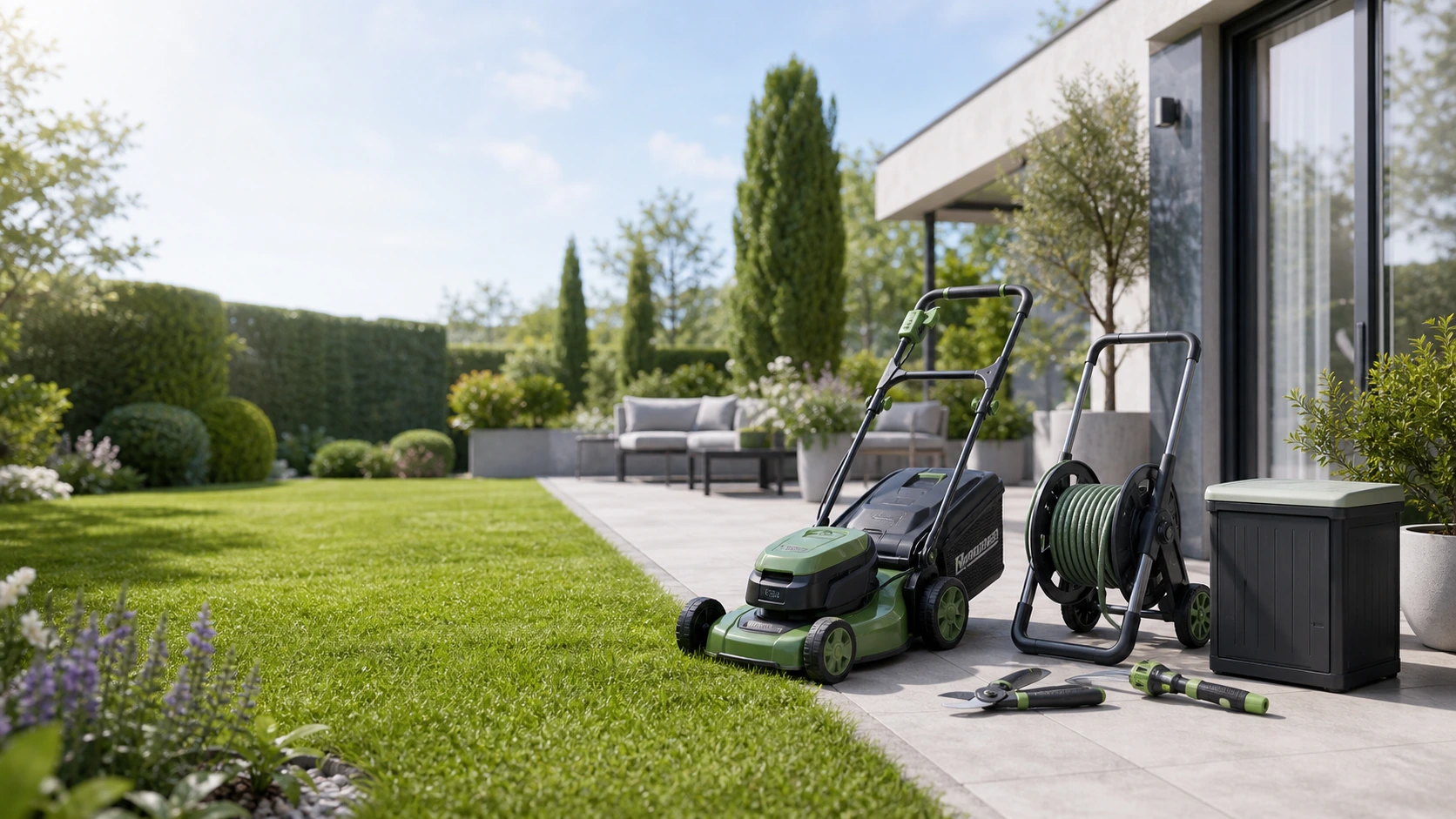
The right type of mower depends on three things: area, terrain, and how much time you are willing to spend. That last criterion is the one most often overlooked, yet it is what really decides between a machine you push and a machine that works in your place. Here is a full tour of the four families.
The corded electric mower: the simplest
Light, quiet, with no engine maintenance and instantly available, the corded mower remains unbeatable on price and simplicity for small plots, say up to 300 or 400 square metres.
It has no run time limit and starts at the press of a button, even after a winter at the back of the garage. There is no petrol to store, no battery to watch and no oil change to plan.
Its constraint is the cable, and it is a serious one. You have to manage it constantly to avoid cutting through it, which calls for a mowing method that works progressively away from the socket. On a complex plot, with borders and obstacles to work around, managing the cable quickly becomes tiresome.
Always use an extension lead of a cross-section suited to its length, fully unwound, plugged into a socket protected by a 30 mA residual current device.
The battery mower: the best compromise today
This is the category that has advanced most, to the point of making petrol debatable on many medium-sized plots.
It keeps the advantages of electric, namely instant starting, relative quiet and no engine maintenance, while removing the cable. Brushless motors now deliver enough torque for dense grass.
The key consideration is not the stated voltage but the energy available, expressed in amp-hours. A 4 Ah battery lasts roughly twice as long as a 2 Ah one at the same voltage. Check whether the battery is included, since it represents a significant share of the price.
One strategic point often overlooked: if you already own cordless tools, stay within the same battery platform where possible. You then share the fleet between mower, hedge trimmer, blower and hand tools, which changes the economics of the whole set-up entirely.
It suits plots up to 500 or 800 square metres depending on capacity, provided you accept a possible charging pause, or keep a second battery.
- Look at amp-hours, not voltage alone
- Check whether the battery is included in the price
- Stay on the same platform as your other tools
- A second battery removes the run time constraint
The petrol mower: power and large areas
Beyond 800 square metres, on undulating ground or with tall dense grass, petrol keeps a real advantage. It does not fade, does not stop, and copes with difficult conditions.
Two options change comfort considerably. Self-propulsion, which drives the wheels, becomes all but essential as soon as there is any slope or significant area: without it you are pushing several dozen kilograms. And cutting width, generally 40 to 55 centimetres, determines the number of passes.
Its trade-offs are well known: significant noise, which means respecting the hours permitted by local by-law, emissions, vibration, and above all regular maintenance. You need to plan for fuel, oil changes, cleaning or replacing the air filter, and the spark plug.
One decisive practical point: never store a petrol mower for winter with fuel in the tank. The fuel goes stale and gums up the carburettor, which is by far the leading cause of a mower that refuses to start in spring.
The robot mower: never thinking about it again
A robot does not replace the other mowers, it changes the logic. Instead of cutting a lot once a week, it cuts a few millimetres every day and drops very fine fragments that break down and fertilise the soil. That is permanent mulching.
The resulting lawn is denser and more even than with conventional mowing, and there is no longer a box to empty or green waste to dispose of.
The criteria to check are the maximum area handled, allowing a margin of at least twenty per cent, the permissible slope expressed as a percentage, and the ability to negotiate narrow passages between zones. Recent models dispense with the boundary wire and locate themselves by satellite, which greatly simplifies installation.
Bear in mind that a robot does not rescue a neglected lawn: you need to mow conventionally before putting it into service. And it does not do the edges, so an edge trimmer remains necessary every two or three weeks.
Mulching, collection or side discharge
This choice influences the result as much as the type of motor, and it is often settled by default.
Collection in a box gives an immediately tidy lawn, but requires frequent emptying and produces a volume of green waste to dispose of, while exporting nitrogen from the soil.
Mulching shreds the grass finely and returns it. It fertilises naturally, eliminates waste and limits evaporation by shading the base of the blades, which is valuable in summer. Its condition for success is mowing often, on dry grass and never too long, failing which it leaves unsightly clumps.
Side discharge suits tall grass and large areas where appearance matters little.
So-called two-in-one or three-in-one mowers let you switch between modes by season, which is the most flexible solution: collection in spring when growth is explosive, mulching the rest of the time.
- Collection: tidy immediately, but waste and nitrogen exported
- Mulching: fertilises and protects against drought, needs frequent mowing
- Side discharge: tall grass, large areas
- Multi-function models: switch by season
Mowing well: height, frequency and safety
The most useful rule is the one-third rule: never cut more than a third of the blade height in a single pass. Cutting too severely stresses the plant, yellows the lawn and encourages moss and weeds.
Keep a height of four to five centimetres. Slightly longer grass shades its own base, resists drought far better and naturally limits weeds. In hot spells, raise the height further rather than spacing out the mowing.
Mow on dry grass: wet grass blocks the discharge channel, sticks under the deck and cuts poorly.
Sharpen the blade at least once a season. A blunt blade tears instead of cutting cleanly, leaving tips that brown within two days and weakening the lawn.
On safety, disconnect the spark plug or remove the battery before any work under the deck, without exception. Wear closed shoes, and check the ground before mowing: a stone thrown by a blade is a dangerous projectile.
- Never cut more than a third of the height
- Cutting height of 4 to 5 cm, more in hot weather
- Mow on dry grass only
- Sharpen the blade at least once a season
- Battery removed or spark plug disconnected before any work
Our recommendation
Below 400 square metres on flat, simple ground, corded electric is ample and costs the least. Between 400 and 800 square metres, battery is the best compromise today, especially if you already own tools on the same platform.
Beyond 800 square metres, on undulating ground or with dense grass, self-propelled petrol remains relevant, provided you accept its maintenance.
And if your priority is to stop spending any time on it at all, a robot changes everything whatever the area, within the limits of its slope and crossing capabilities.
- Under 400 m² flat: corded electric
- From 400 to 800 m²: battery, ideally on a shared platform
- Over 800 m² or marked slopes: self-propelled petrol
- No time to spend on it: robot mower
Frequently asked questions
Which mower for a 600 m² garden?
A battery mower is the best compromise at that size today: no cable to manage, instant starting, no engine maintenance. Look at capacity in amp-hours rather than voltage, check whether the battery is included, and consider a second battery. If you already own cordless tools, stay on the same platform to share the fleet.
What height should I cut my lawn to?
Between four and five centimetres, and higher in hot weather. Slightly longer grass shades its own base, resists drought far better and naturally limits moss and weeds. Also respect the one-third rule: never cut more than a third of the blade height in one pass, or you stress the plant and yellow the lawn.
Mulching or collection, which should I choose?
Mulching shreds the grass finely and returns it: it fertilises naturally, eliminates green waste and limits evaporation by shading the base of the blades. It does require mowing often, on dry grass and never too long. Collection gives an immediately tidy result but exports nitrogen and generates waste. A multi-function model lets you switch by season.
Why will my petrol mower not start in spring?
In the great majority of cases, because it was stored with fuel in the tank. The fuel goes stale over winter and gums up the carburettor. It is by far the leading cause of a refusal to start. Always empty the tank before winter storage, or run the engine until it runs dry.
Is a robot mower suitable for every garden?
No. Check three points above all: the maximum area handled, allowing a margin of at least twenty per cent, the permissible slope expressed as a percentage, and the width of the passages between zones. Bear in mind too that a robot does not rescue a neglected lawn, you need to mow conventionally before commissioning it, and that it does not do the edges.
Do I need to sharpen my mower blade?
Yes, at least once a season. A blunt blade tears the grass instead of cutting it cleanly: the tips brown within two days and the lawn weakens. Before any work under the deck, always remove the battery or disconnect the spark plug, without exception, and check the blade balance after sharpening.
Ready to take the next step?
Browse our Garden & Outdoor selection