
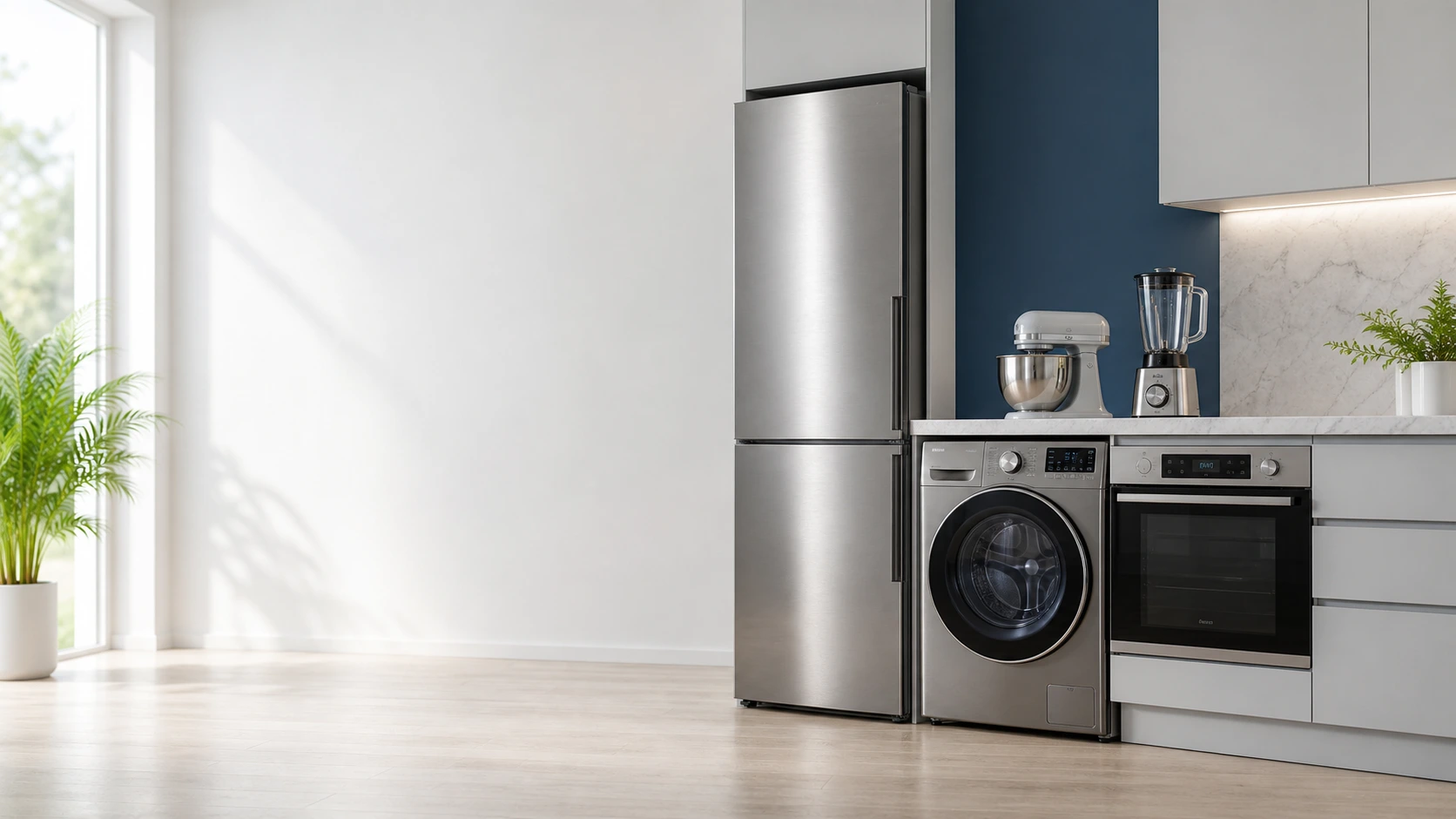
A fridge is the only appliance in the home that runs twenty-four hours a day, all year round, for ten to fifteen years. That permanence changes the buying logic entirely: a difference in energy rating is paid for, or recovered, over a decade. Here is how to weigh capacity, format, cooling technology and consumption.
Choosing the right capacity
Usable capacity is measured in litres. The common rule is to allow 100 to 150 litres for one person, then around 50 litres per additional person. A couple therefore lands between 200 and 300 litres, a family of four at 300 litres and above.
These figures need adjusting to your actual habits, which weigh more than the number of occupants. If you do one big weekly shop, you need headroom. If you buy fresh every other day, a more modest capacity is plenty.
Beware the bigger-is-better reflex. A half-empty fridge consumes more than a well-filled one, because the cold air is renewed at every opening whereas food and liquids form a mass that holds the cold. Oversizing therefore costs twice, at purchase and then every month.
Finally, check usable capacity rather than gross capacity. The former accounts for shelves, drawers and genuinely usable space, and it is the only figure that concerns you.
- One person: 100 to 150 litres
- Add around 50 litres per additional person
- Large weekly shops: allow headroom
- A half-empty appliance consumes more than a full one
Fridge-freezer, American, single door or multi-door
The fridge-freezer, with the refrigerator on top and the freezer below, is the most widespread and most versatile format. Its logic is ergonomic: the most-used compartment sits at eye level, while the freezer, opened less often, takes the lower position.
The American format, with two side-by-side doors, offers large capacity and often a water and ice dispenser. In return it demands significant width and generous clearance for the doors to open. One point rarely anticipated: because the freezer compartment is tall and narrow, it accommodates large items and bulky ready meals poorly.
The multi-door format, with two upper doors and one or two lower drawers, combines the capacity of an American model with better organisation, sometimes including a convertible-temperature compartment. It is the most flexible format, and the most expensive.
The single-door model, with no freezer compartment or just a small freezer box, suits small spaces, holiday homes, or use alongside a separate freezer.
Finally, if a water dispenser tempts you, check whether it needs a mains water connection or works from a reservoir. The former assumes plumbing is available where you plan to install it.
Static, air-cooled or frost-free
This is the technical choice with the greatest day-to-day impact, and it is too often reduced to the question of defrosting alone.
Static cooling lets air circulate naturally. Cold air, being denser, sinks: stratification therefore develops, with a distinctly cooler zone at the bottom. It is the simplest, cheapest and quietest system, but it requires regular defrosting and organising food according to temperature zones.
Air-cooled models add a fan that evens out the temperature in the fridge compartment. It is a good compromise, but it does not eliminate frost.
Frost-free cooling, often called No Frost, dries the circulating air, which prevents frost from forming: no defrosting is ever needed. Temperature is even and recovers faster after the door is opened. The downside is that this dried air desiccates unwrapped food, particularly fruit, vegetables and cheese. The remedy is simple: airtight containers and closed crisper drawers.
Many appliances now combine frost-free in the freezer, where frost is most troublesome, with air-cooled or static in the fridge. That is often the best trade-off.
- Static: cheap and quiet, manual defrosting, pronounced cold zones
- Air-cooled: even temperature in the fridge, frost still present
- Frost-free: no defrosting, but dries out unwrapped food
- Mixed, frost-free in the freezer only: often the best compromise
Reading the energy label correctly
The European label has been reformed: the scale now runs from A to G, and the former A+, A++ and A+++ classes have disappeared. That overhaul deliberately left classes A and B all but empty at the outset, to leave room for technical progress. An appliance rated C or D on the new scale is therefore a good appliance, not to be confused with an old C.
The genuinely useful figure is not the letter but the annual consumption in kilowatt-hours, shown just beneath it. That is what lets you compare two models and work out the real extra cost of a less efficient one.
Always do the sum across the service life. A gap of 100 kWh per year, multiplied by twelve years of use, comes to 1,200 kWh: depending on electricity prices, that frequently exceeds the price difference between the two models at purchase. On an appliance that never switches off, energy efficiency is not a nice-to-have, it is the central calculation.
The label also carries a QR code linking to the European EPREL database, which gives the official and complete product record.
Noise, decisive in an open-plan kitchen
A fridge noise is endured continuously, and it has become a major criterion with the spread of kitchens open onto living rooms.
Because the decibel scale is logarithmic, three decibels more means twice the sound power. The gap between a 35 dB appliance and a 42 dB one, which looks trivial on paper, is very noticeable in a quiet room in the evening.
Below 40 dB, the appliance stays discreet. Below 35 dB, it becomes genuinely inaudible in normal use. If your kitchen opens onto the living space, or the home is a studio, this criterion deserves a high place among your priorities.
Installation and placement
A fridge rejects heat through the grille at its back. It therefore needs free space behind and at the sides, generally a few centimetres, for that air to circulate. An appliance built into too tight a recess consumes more and wears out faster.
Do not install it against an oven, a dishwasher or a radiator, nor in direct sunlight. Every extra degree in the ambient air translates into extra work for the compressor.
Check the climate class shown on the rating plate, which defines the ambient temperature range for guaranteed operation. An appliance in class N is not designed for an unheated garage in winter or a conservatory in summer, and will behave erratically in those conditions.
After transport, let the appliance stand upright for several hours before plugging it in, so the compressor oil settles back. Finally, check which way the door opens: it is reversible on many models, but not all.
- Free space at the back to reject heat
- Away from the oven, the dishwasher and direct sunlight
- Climate class suited to the location (mind the garage)
- Several hours upright after transport before switching on
Setting it and loading it well
The fridge compartment should be set to around 4 °C, and the freezer to -18 °C. Going lower does not preserve food better and noticeably increases consumption.
Even with frost-free cooling, how you load matters. The most delicate items, meat and fish, belong in the coldest zone, generally at the bottom just above the drawers. Dairy and leftovers occupy the middle, drinks and condiments the door shelves, which are the mildest zone and the most exposed to variation.
Never store a dish while it is still hot: it raises the temperature of the whole compartment and forces the compressor. Let it cool in the open air first.
Dust the rear grille once or twice a year: when clogged, it rejects heat poorly and degrades efficiency. Check the door seal too, whose fatigue is a classic cause of excess consumption. The test is to trap a sheet of paper in the closed door: if it slides out without resistance, the seal needs replacing.
Frequently asked questions
What fridge capacity do I need for a family of four?
Allow 300 litres of usable capacity and above, starting from 100 to 150 litres for the first person then around 50 litres per additional person. Adjust for your habits: large weekly shops need headroom, buying fresh every other day needs far less. Avoid oversizing, since a half-empty appliance consumes more than a well-filled one.
Should I choose a No Frost fridge?
Frost-free cooling removes defrosting entirely and keeps an even temperature that recovers faster after opening. In return, the dried air desiccates unwrapped food, notably fruit, vegetables and cheese: airtight containers and closed drawers become necessary. Many appliances adopt the best formula, frost-free in the freezer where frost is most troublesome, air-cooled or static in the fridge.
Is a fridge rated C a poor appliance?
No. The European energy label has been reformed: the scale runs from A to G and the former A+, A++ and A+++ classes have gone. Classes A and B were deliberately left all but empty to leave room for technical progress. A C or a D on the new scale corresponds to a good appliance. Compare the annual consumption in kilowatt-hours shown beneath the letter instead.
What temperature should I set my fridge to?
Around 4 °C for the fridge compartment and -18 °C for the freezer. Going lower does not improve preservation and noticeably increases the consumption of an appliance that already runs continuously. Place meat and fish in the coldest zone, generally just above the drawers, and reserve the door shelves for drinks and condiments.
Can I put a fridge in a garage?
Only if its climate class allows, information shown on the rating plate. An appliance in class N is designed for a restricted ambient temperature range and will behave erratically in an unheated garage in winter or a conservatory in summer. Check this before buying, it is a frequent cause of unexplained malfunction.
Why is my fridge consuming more and more?
Two causes dominate. A rear grille clogged with dust rejects heat poorly: dust it once or twice a year. And a tired door seal lets warm air in continuously: trap a sheet of paper in the closed door, and if it slides out without resistance the seal needs replacing. Check too that no new heat source has been installed nearby.
Ready to take the next step?
Browse our Refrigerators selection