
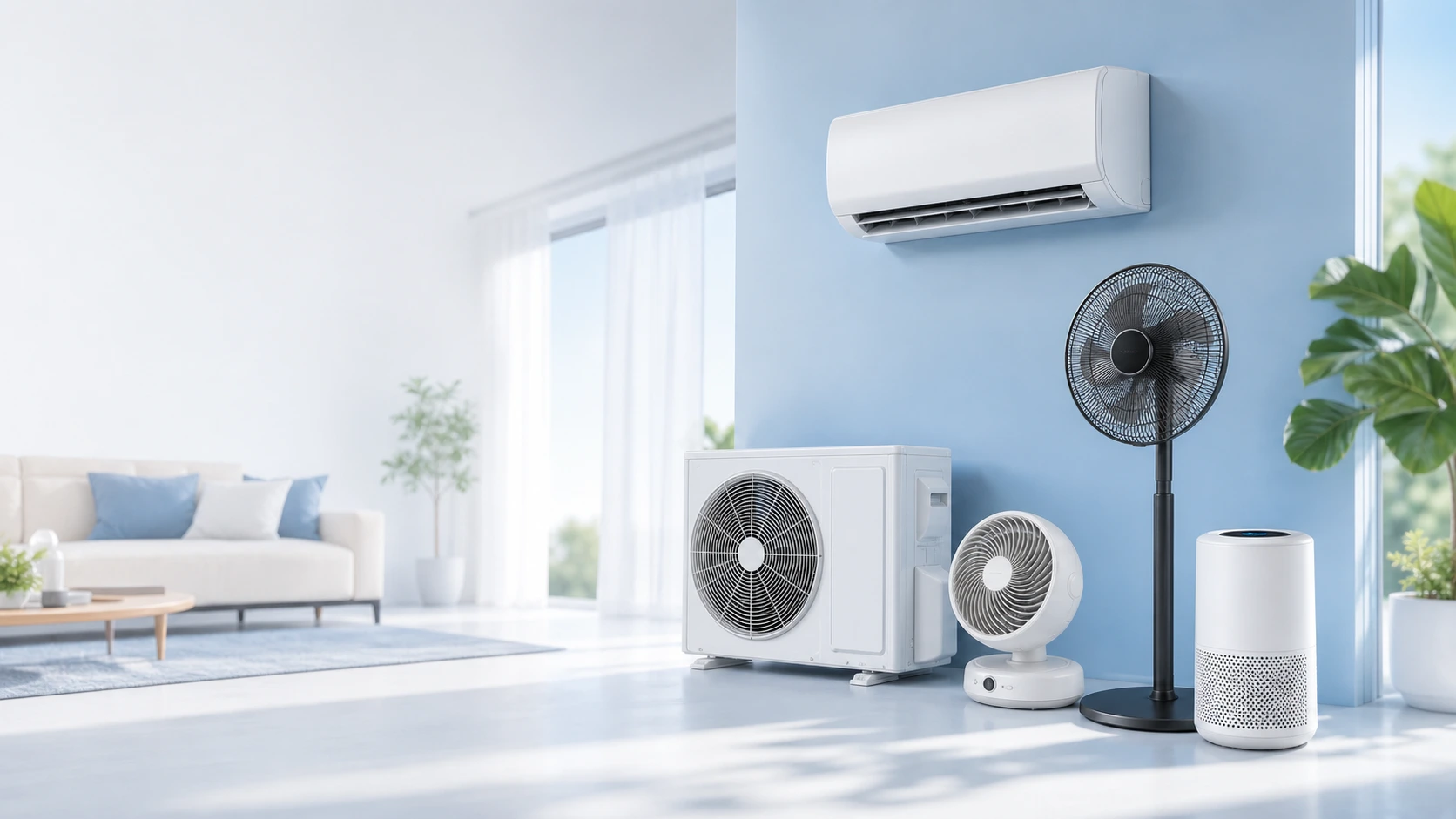
A correctly sized air conditioner cools efficiently without wasting energy. An oversized or poorly chosen one inflates your bill, runs noisily and wears out early. Here are the points to check before buying, in order, from calculating capacity to the legal requirements around installation.
Estimating the capacity you need (in BTU)
Cooling capacity is expressed in BTU/h, an imperial unit that remains universal in this market. As a general rule, allow roughly 100 BTU per square metre for a reasonably insulated room with a standard ceiling height.
For a 15 m² bedroom, a 9,000 to 12,000 BTU unit is usually enough. A 35 m² south-facing living room will call for closer to 18,000 BTU. That baseline then needs adjusting for several factors that carry real weight.
Sun exposure comes first: a south-facing room, or one under the roof, can need 20 % more capacity. The number of occupants matters too, since each person radiates heat continuously, as do electronics and the appliances in an open-plan kitchen.
Beware the opposite mistake, which is very common: oversizing improves nothing. An overpowered unit reaches its target temperature too quickly, shuts off, restarts, and repeats those short cycles endlessly. The result is poor dehumidification, a cold and clammy feel, higher consumption and faster wear. Sizing accurately beats leaving yourself a safety margin.
- Baseline: roughly 100 BTU per m²
- Very sunny room or under the roof: add 10 to 20 %
- Each permanent occupant: add about 600 BTU
- Open-plan kitchen or many appliances: allow some margin
- Never oversize: short cycling and poor dehumidification
Portable or split: which installation?
A portable single-unit air conditioner houses every component in one wheeled cabinet. It is easy to set up and store away, which makes it the obvious answer in rented accommodation or for occasional use. Hot air is expelled through a hose fed out of a partly open window.
A split system separates the unit in two: a discreet, quiet indoor unit and a compressor installed outside. That architecture changes everything. Efficiency is markedly better, noise in the room is far lower since the noisy part sits outdoors, and more capacity is available.
The decision comes down to a simple trade-off. If you need a flexible solution with no building work and no landlord or building-management approval, a portable unit is the only realistic option. For lasting comfort in a room you use every day, a split system is the benchmark, provided you accept a fixed installation.
- Portable: movable, no building work, limited efficiency and acoustic comfort
- Split: far better efficiency, very quiet indoors, fixed installation
- Rented flat or restrictive building rules: portable
- Living room used daily: split
Air exhaust, the weak point of portable units
This is the point almost nobody checks before buying, and it explains most of the disappointment with portable air conditioners.
A single-hose portable unit draws air from the room to cool its condenser, then expels it outside. It therefore creates negative pressure: warm outside air is pulled in through gaps, doorways and adjoining rooms to compensate. Part of the cooling work is lost continuously.
Dual-hose models, one for intake and one for exhaust, draw their cooling air from outside and create no such negative pressure. Their real-world efficiency is noticeably better, for barely more bulk.
In every case, seal the window properly. A well-fitted window sealing kit that leaves only a snug opening for the hose transforms the result. Keep the hose as short and straight as possible too: every bend and every unnecessary metre warms the expelled air and degrades performance.
- Single hose: creates negative pressure, real efficiency suffers
- Dual hose: clearly more effective, worth preferring
- Window sealing kit is essential
- Short, straight hose with no unnecessary bends
Energy rating, SEER and real running cost
The European energy label shows efficiency in cooling mode, and in heating mode for reversible models. It rests on two seasonal indicators worth knowing how to read.
SEER measures cooling efficiency across a full season, accounting for part-load operation and not just full-power running. It is the figure that best represents real use. SCOP is its heating-mode equivalent. The higher these values, the less the unit consumes for the same service.
A model rated A++ or better consumes considerably less over a season than an entry-level one, and the price difference is recovered all the faster if the unit runs for long spells each summer. For intensive use in a hot region, the arithmetic almost always favours the better-rated model.
Check the refrigerant too. R32, now widespread, has a far lower global warming potential than the older R410A, along with better efficiency.
- SEER: seasonal cooling efficiency, the most meaningful figure
- SCOP: the heating-mode equivalent
- Aim for A++ or better for intensive use
- R32 refrigerant preferable to R410A
Noise, a badly underrated criterion
Noise is measured in decibels, on a logarithmic scale: three decibels more means twice the sound power. A gap that looks trivial on a spec sheet is very audible in a bedroom.
Below 45 dB for an indoor unit, night-time comfort is preserved. The best split systems drop below 25 dB in night mode, which is all but imperceptible. A portable unit, carrying its compressor inside the room, sits structurally much higher, often between 50 and 65 dB.
Treat quoted figures with care: they generally correspond to the lowest fan speed, not everyday running. Look for the full range, from minimum to maximum.
For a split system, think about your neighbours as well. The outdoor unit emits noise that can legitimately be a nuisance, and noise between neighbouring properties is regulated under the French public health code. Keep it away from adjoining windows and avoid placing it in a corner that reflects sound.
Reversible: heating in winter too
A reversible air conditioner produces cold in summer and heat in winter by reversing its cycle: it then works as an air-to-air heat pump. This is by far the strongest economic argument for the technology.
The principle is that it does not create heat, it moves it. Where an electric convector returns at best the equivalent of the energy it consumes, a heat pump returns several times more by capturing warmth from outside air, even in cold weather. That is what SCOP expresses.
Two limits are worth knowing. Efficiency falls when outdoor temperatures drop sharply, although recent models remain effective well below zero. And the heat produced is blown warm air, drier and less even than radiant heating.
If you are considering year-round use, check that the reversible function is present, look at the quoted SCOP, and note the guaranteed minimum operating temperature.
Installing a split system: what the regulations require
A point often discovered too late. The refrigerants used in air conditioners are fluorinated greenhouse gases, governed by European regulation. Handling them, meaning commissioning a refrigerant circuit, charging it or servicing it, is restricted to companies holding a certificate of competence, with staff holding an individual attestation of aptitude.
In practical terms, a conventional split system is not a do-it-yourself installation. You need to budget for professional fitting from the outset, and it is not a trivial cost.
So-called ready-to-fit models exist, supplied with a pre-charged circuit and quick-connect couplings, designed to limit the intervention required. Check precisely what the manual permits, and remember that any later work on the circuit will fall to a qualified professional regardless.
In a block of flats, installing an outdoor unit alters the appearance of the façade and normally requires approval from the owners association. Find out before buying, not after.
- Refrigerant handling restricted to certified companies
- Budget for professional fitting from the start
- Ready-to-fit models: read the manual carefully
- Shared building: approval needed for the outdoor unit
Setting it properly so nothing is wasted
The best unit, badly set, consumes more than an average one used well. The most profitable rule is to keep the gap with the outdoor temperature to around 5 to 7 degrees. Dropping to 19 °C when it is 35 °C outside roughly doubles consumption, causes unpleasant thermal shocks and does not improve perceived comfort.
A setting around 26 °C, combined with good air movement, delivers thoroughly satisfying comfort for a much smaller bill. Automatic mode, which modulates fan speed according to the gap from the target, is almost always more economical than a fixed manual setting.
Close shutters and curtains on the sunny side during the day: stopping heat from getting in costs infinitely less than removing it afterwards. And do not leave the unit running with doors and windows open, an obvious point that is nonetheless the leading cause of excess consumption observed in practice.
Minimal but essential maintenance
Filters should be cleaned every two to four weeks during the season of use. A clogged filter reduces airflow, cuts efficiency and raises consumption, while degrading the quality of the air you breathe.
Cleaning is simple: remove the filter, vacuum it, rinse it in lukewarm water if the manufacturer allows, and let it dry completely before refitting. A filter put back damp encourages mould and odours.
At the end of the season, run the unit in fan-only mode for a few hours to dry out the circuit before storage. That is the step that prevents the musty smell when you start it up the following summer.
Frequently asked questions
How many BTU do I need for a 20 m² room?
Allow roughly 2,000 BTU for 20 m² using the 100 BTU per square metre baseline, which points to a 9,000 to 12,000 BTU unit once adjustments are applied. Add 10 to 20 % if the room faces south or sits under the roof, and around 600 BTU per permanent occupant. Avoid oversizing: an overpowered unit short-cycles, dehumidifies poorly and consumes more.
Portable or split air conditioner: which should I choose?
A portable unit makes sense in rented accommodation, in buildings with restrictive rules, or for occasional use: no building work and easy storage. A split system offers far better efficiency and much quieter operation in the room, since the compressor sits outside, but it requires fixed installation by a certified professional. For a living room used daily, the split system remains the benchmark.
Why does my portable air conditioner cool so poorly?
The most common cause is air exhaust. A single-hose model draws air from the room to cool its condenser, creating negative pressure that pulls warm outside air in through gaps. Check the window seal, shorten and straighten the hose, and bear in mind that a dual-hose model delivers noticeably better real-world efficiency.
Can I install a split air conditioner myself?
Not in the general case. Refrigerants are fluorinated greenhouse gases whose handling is restricted to companies holding a certificate of competence. Professional fitting therefore needs to be part of your budget. Some ready-to-fit models, with a pre-charged circuit and quick couplings, limit the work involved: read carefully what the manual permits.
What temperature should I set my air conditioning to?
Keep the gap with the outdoor temperature to 5 to 7 degrees, which puts the setting around 26 °C during a heatwave. Dropping to 19 °C when it is 35 °C outside roughly doubles consumption and causes unpleasant thermal shocks without improving perceived comfort. Automatic mode is almost always more economical than a fixed manual setting.
What do SEER and SCOP mean on the label?
SEER measures cooling efficiency across a full season, accounting for part-load operation rather than full-power running alone, which makes it the figure that best reflects real use. SCOP is its heating-mode equivalent for reversible models. The higher these values, the less the unit consumes for the same service delivered.
Ready to take the next step?
Browse our Air Conditioning & Ventilation selection