
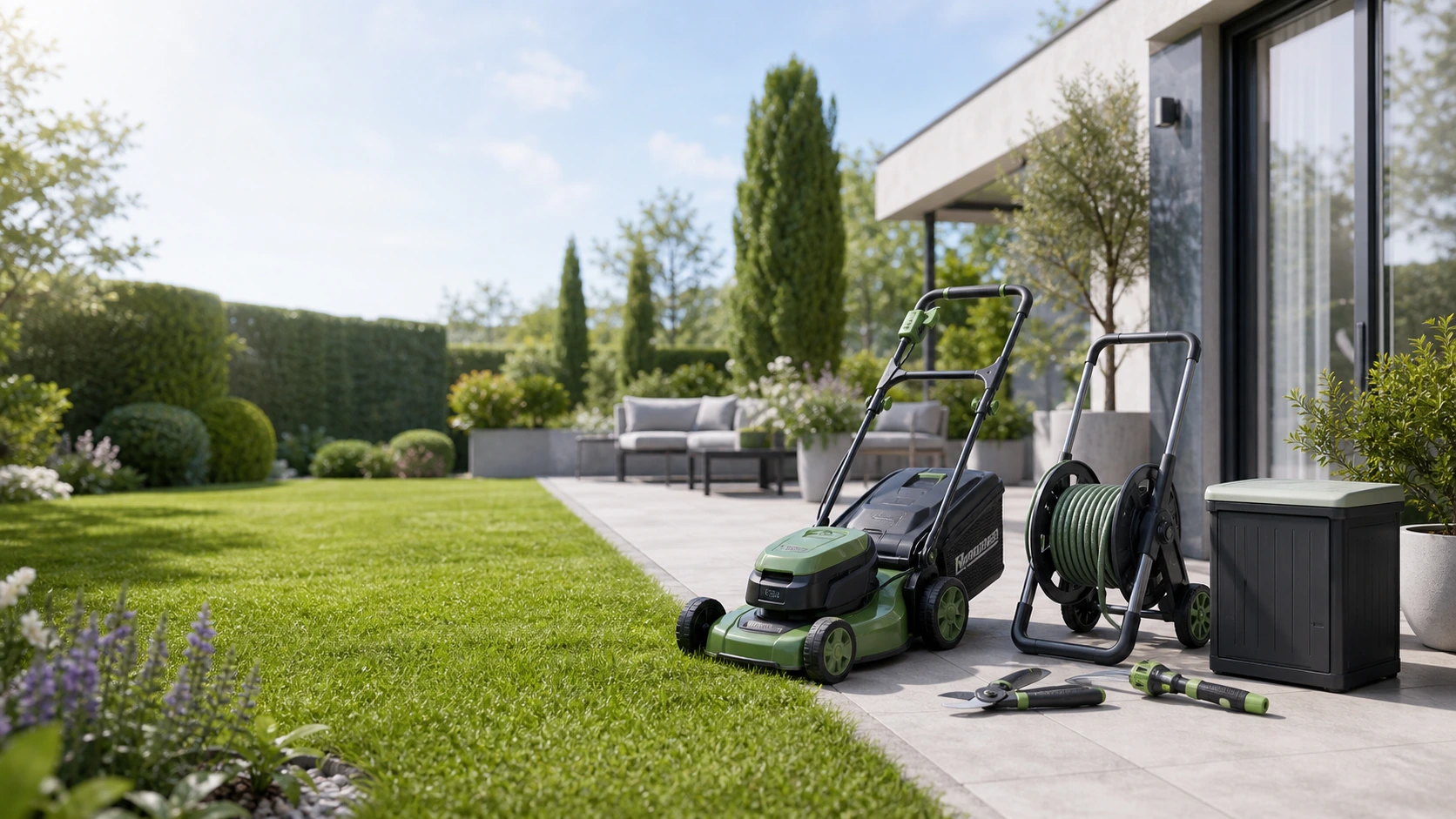
A fine garden does not necessarily demand hours of work. What it demands above all is the right actions at the right time, because most gardening effort goes into repairing the consequences of a bad habit picked up earlier. Here is how to organise maintenance season by season, with a minimum of time.
Mowing: regular and at the right height
This is the most frequent task, and therefore the one whose mistakes cost most. The one-third rule should guide every pass: never cut more than a third of the blade height at a time. A severe cut stresses the plant, which draws on its root reserves to rebuild its foliage, yellows, and gives way to moss.
Keep a height of four to five centimetres. Slightly longer grass shades its own base, which limits evaporation and keeps the soil cooler. It also naturally smothers young weeds by depriving them of light. A closely shorn lawn is more fragile, thirstier and far more prone to weeds.
In a drought, raise the cutting height further rather than spacing out the mowing. That is the reflex that saves a lawn in summer.
A robot mower automates the task entirely: it passes a little every day, leaves a dense lawn and recycles the clippings into natural fertiliser. On a substantial lawn it is the only equipment that genuinely removes the chore rather than easing it.
- Never more than a third of the height at a time
- Height of 4 to 5 cm, raised in hot weather
- Mow on dry grass, with a sharp blade
- Slightly longer grass resists better and smothers weeds
Watering effectively
The most important principle fits in one sentence: water less often, but more generously. Light daily watering only wets the surface and encourages roots to stay near it, which leaves the lawn entirely dependent on you and unable to withstand the first heatwave.
A generous watering once or twice a week, penetrating deeply, forces roots downward in search of water instead. The lawn then becomes markedly more self-sufficient and resilient.
Timing matters just as much. Water early in the morning by preference: evaporation is minimal and the foliage has time to dry during the day. Evening watering also works but leaves foliage damp all night, which encourages fungal disease. In full sun at midday, much of the water evaporates before reaching the roots.
A useful benchmark for dosing: place a straight-sided container on the lawn while watering. When it holds one to two centimetres of water, the weekly dose has been reached.
Finally, check the water restrictions in force in your commune: prefectural drought orders frequently limit lawn watering in summer, with mandatory hours.
- Less often but more generously, to drive roots downward
- Early morning by preference, never in full sun
- 1 to 2 cm of water per week, measured in a container on the ground
- Check prefectural restrictions during droughts
Feed the soil rather than the plant
A lawn that yellows every summer is almost always the symptom of impoverished or compacted soil, not of a one-off lack of fertiliser.
Mulching, which means leaving the finely shredded grass in place instead of collecting it, returns to the soil the nitrogen contained in the cut blades. Practised throughout the season, it covers a significant share of the lawn needs and eliminates green waste. It is the most profitable action in the garden.
If the soil is compacted, particularly in areas of foot traffic, aerating in spring or autumn makes a spectacular difference. The idea is to perforate the soil so that air and water reach the roots. A simple aerating roller or a garden fork is enough on a small area.
Scarifying, which is more intensive, removes the accumulated thatch that stops water penetrating. Once a year in spring is ample when it is needed, and it is not necessary every year on a healthy lawn.
The calendar of major tasks
Maintenance becomes far lighter when it follows the rhythm of the seasons rather than urgency. Here are the fixed points that structure a garden year.
- Late winter: prune summer-flowering shrubs, clean tools
- Spring: scarify, aerate, first mow, gradually resume watering
- Late spring: heaviest mowing rhythm, mulching throughout
- Summer: cutting height raised, watering spaced out but generous
- Autumn: clear leaves, final mow slightly higher, plant
- Winter: service and store equipment, drain petrol mowers
Fallen leaves, a resource rather than a chore
Autumn brings its volume of leaves, and the usual reflex is to clear it all away. That is a waste, because those leaves are free organic matter.
Do remove them from the lawn: a thick layer deprives the grass of light and creates yellow patches that will take months to recover. On the other hand, redistribute them at the base of hedges and in beds, where they form a natural mulch that protects against frost, limits evaporation and breaks down into humus.
A blower-vacuum-shredder saves a great deal of time on this task, and its shredding mode considerably reduces the volume while speeding up decomposition. The stated shredding ratio indicates how much the volume is reduced.
Take care, however, not to leave a thick, compacted layer of wet leaves on a bed: it can smother low-growing plants. An open layer a few centimetres deep is enough.
Setting the garden up to be enjoyed
Beyond maintenance, a garden only makes sense if you settle into it. A few simple arrangements turn a green space into an extra living room.
A shaded corner is the first comfort investment, because in our summers it is shade that makes an outdoor space usable during the day. A water feature, an above-ground pool or a hot tub, extends the use of the garden across the whole warm season.
A barbecue moves meals outdoors and very quickly becomes the centre of gravity of summer. Site it on a stable, clear surface, away from planting and downwind of where people sit.
Soft lighting, even minimal, radically changes evening use. A few warm points of light beat a single floodlight, which dazzles and flattens depth.
Finally, think about storing equipment. A shed that keeps the mower, tools and cushions dry markedly extends their life, and saves time at every use.
Looking after equipment so it lasts
The place where most money is lost in a garden is not the purchase, it is the premature replacement of poorly maintained equipment.
Clean cutting tools after every use. Sap and plant residue are corrosive and sticky: a pass with a brush and an oiled cloth is enough to prevent rust. Sharpen blades at least once a season, mower and secateurs alike.
For petrol equipment, never store for winter with fuel in the tank: the fuel goes stale and gums up the carburettor, the leading cause of a refusal to start in spring.
For battery tools, store batteries at around half charge, in a frost-free and temperate space. A battery left completely flat over winter may never take a charge again.
Finally, always cut the power, remove the battery or disconnect the spark plug before working on any cutting part. Without exception, including for simply clearing jammed grass.
- Clean cutting tools after every use
- Sharpen blades at least once a season
- Petrol: tank emptied before winter storage
- Batteries: stored at half charge, frost-free
- Power cut before any intervention
Frequently asked questions
How often should I water my lawn?
Less often but more generously: once or twice a week with watering that penetrates deeply, rather than light daily watering. Superficial watering keeps roots near the surface and leaves the lawn dependent and fragile. Aim for one to two centimetres of water per week, measurable by placing a straight-sided container on the lawn while watering.
When is the best time to water?
Early in the morning by preference: evaporation is minimal and the foliage has time to dry during the day. Evening watering works too but leaves the foliage damp all night, which encourages fungal disease. Avoid full midday sun entirely, since much of the water evaporates before reaching the roots.
Why does my lawn yellow every summer?
It is almost always a sign of impoverished or compacted soil rather than a one-off lack of fertiliser. Three levers: raise the cutting height to five centimetres or more in hot weather, mulch to return nitrogen to the soil, and aerate in spring or autumn if the soil is compacted, particularly in areas of foot traffic.
What should I do with fallen leaves in autumn?
Do remove them from the lawn, where a thick layer deprives the grass of light and creates lasting yellow patches. On the other hand, redistribute them at the base of hedges and in beds: they form a natural mulch that protects against frost, limits evaporation and breaks down into humus. A shredder greatly reduces the volume and speeds decomposition.
Do I need to scarify my lawn every year?
No, it is not necessary on a healthy lawn. Scarifying removes the thatch that stops water penetrating: once a year in spring is ample when it is useful. Aeration, which is less aggressive, often brings more benefit on soil that is simply compacted, and can be done in spring or autumn.
How should I store garden tools for winter?
Clean the cutting parts and wipe them with an oiled cloth against rust, then sharpen the blades. For petrol mowers, empty the tank without fail: fuel goes stale and gums up the carburettor, the leading cause of a refusal to start in spring. For battery tools, store batteries at around half charge in a frost-free space, since a battery left completely flat may never take a charge again.
Ready to take the next step?
Browse our Garden & Outdoor selection