
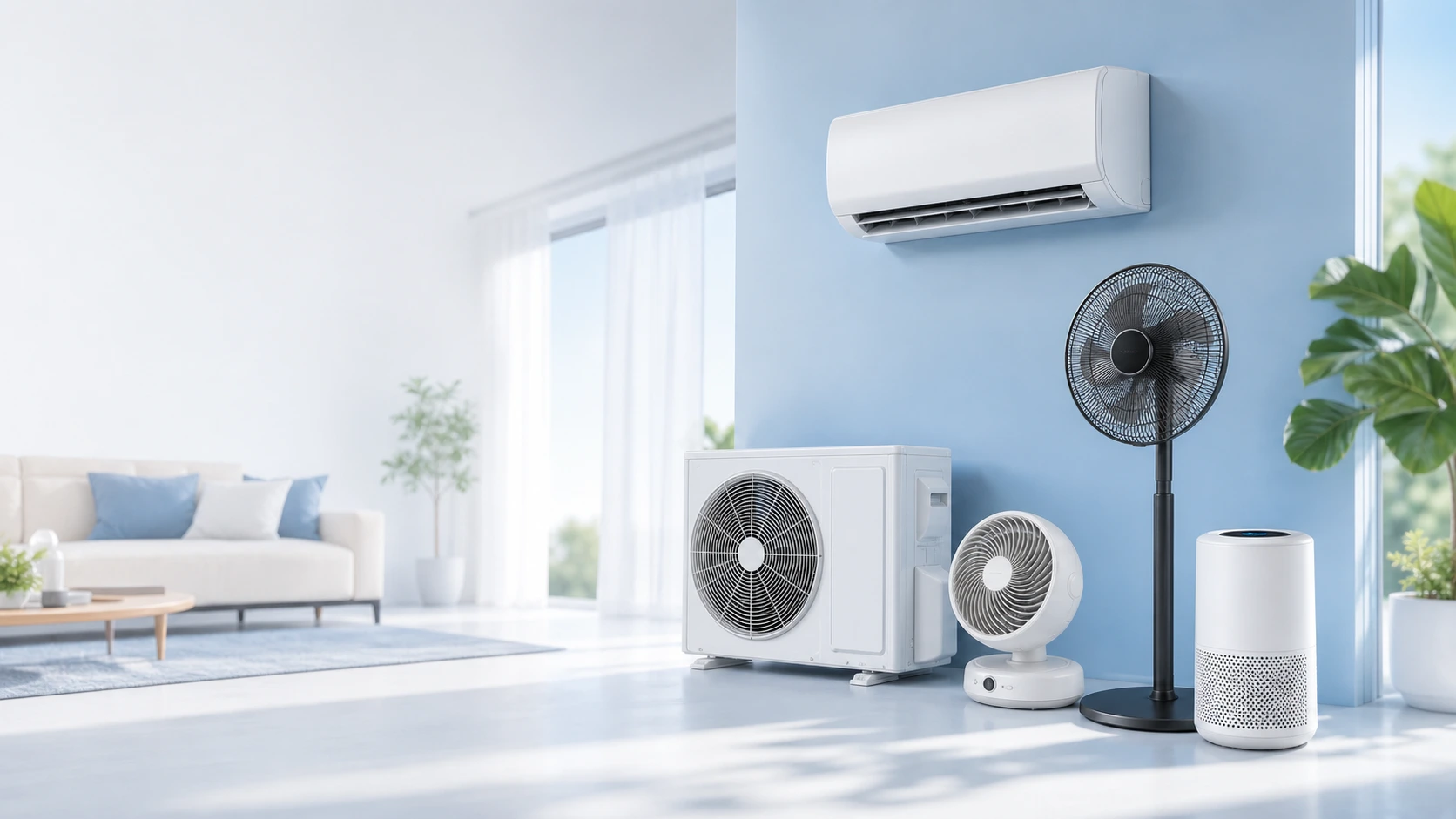
Faced with heat, two solutions are often set against each other: the fan, simple and cheap to run, and the air conditioner, more powerful. The difference is not one of degree but of nature: one moves air, the other removes heat. Understanding that distinction saves you from buying the wrong appliance and being disappointed.
A fan moves air, it does not cool it
This is the misunderstanding at the root of most disappointment. A fan does not lower the temperature of a room. It moves air, and that movement speeds up the evaporation of sweat at the surface of your skin. That evaporation is what produces the sensation of coolness.
The consequence is direct: the effect only exists for someone in the airflow. A fan running in an empty room achieves nothing, and even warms the air very slightly through its motor.
That said, the sensation of coolness is real and significant. Decent airflow can feel like several degrees less, which is very often enough to make an evening comfortable.
Its limit is physiological. Above roughly 35 °C, the moving air becomes warmer than your skin: the fan then blows hot air over your body, which accelerates dehydration without cooling you. In a heatwave, a fan on its own becomes counterproductive.
- Acts on the person, not on the room
- Feels like several degrees less within the airflow
- No effect at all in an unoccupied room
- Becomes ineffective, even harmful, above 35 °C
An air conditioner genuinely removes heat
An air conditioner does not stir air, it extracts. It captures the heat present in the room and rejects it outside, which brings the thermometer down by several degrees whether or not anyone is present.
The second effect often matters more than the temperature itself: it dehumidifies. By condensing moisture on its evaporator, it lowers relative humidity. And humidity is what prevents sweat from evaporating, and therefore what makes heat unpleasant. A dry room at 26 °C is far more comfortable than a clammy one at 24 °C.
That performance has a cost. Consumption runs into hundreds or thousands of watts, against a few dozen for a fan, and the initial outlay is on another scale entirely.
An honest comparison
The two appliances are not in the same category, either in price or in outcome. Here are the differences that genuinely matter at the point of decision.
- Consumption: a few dozen watts against several hundred to over a thousand
- Effect on room temperature: none for a fan, several degrees for an air conditioner
- Dehumidification: none for a fan, significant for an air conditioner
- Installation: none for a fan, fixed and regulated for a split system
- Portability: total for a fan, limited or nil for an air conditioner
- Noise: very low on a good fan, variable by type of air conditioner
The option almost nobody considers: both
Setting the two appliances against each other is largely artificial, and combining them is often the best economic strategy.
The principle is simple: an air conditioner set to 26 °C, with a fan moving the air, delivers the same perceived comfort as an air conditioner set to 22 °C, for far lower total consumption. The fan uses a tiny fraction of what the air conditioner saves by raising its target by four degrees.
Air movement also solves a classic shortcoming of air conditioning: stratification, those cold pockets near the unit and lukewarm ones at the far end of the room. A ceiling or pedestal fan evens everything out.
If you need to equip yourself gradually, start with the fan. You will then know precisely under what conditions it stops being enough, and you will size the air conditioner accordingly.
Middle-ground solutions and their limits
An evaporative cooler, sometimes called an air cooler, passes air through a damp medium. Evaporation absorbs energy from the air, which cools slightly. Its consumption stays close to that of a fan.
Its drawback is structural and worth knowing before you buy: it adds humidity to the room. In an already humid climate it therefore worsens discomfort rather than easing it. It only gives interesting results in dry air, and only if you ventilate.
A misting fan follows the same logic with the same reservations, and suits a terrace far better than a closed bedroom.
The ceiling fan, often overlooked, deserves a mention: it moves a large volume of air for very low consumption, takes up no floor space, and proves particularly well suited to living rooms.
Choosing a good fan
Not all fans are equal, and the decisive criterion is not stated power but airflow relative to noise.
Blade diameter matters more than rotation speed: a large diameter turning slowly moves a great deal of air quietly, whereas a small fan has to spin fast, and therefore whine, for a lesser result. For a bedroom, that is the number one criterion.
Look for enough speed settings, a night mode, and oscillation that avoids a continuous draught on one part of your body, a common cause of stiffness on waking. A sleep timer is very useful for drifting off.
Models with DC motors consume noticeably less and run more quietly at equal airflow than conventional motors, for a modest premium that is quickly recovered if the appliance runs every summer night.
- Large blade diameter: more air, less noise
- Night mode and sleep timer for the bedroom
- Oscillation, to avoid a continuous draught on the body
- DC motor: quieter and more frugal
What matters more than the appliance itself
No appliance compensates for a home that soaks up heat all day. Managing solar gain often has more effect than the equipment, and it costs nothing.
Close shutters and curtains from the morning on exposed elevations: preventing heat from entering is infinitely more effective than trying to remove it later. An external shutter stops radiation before it passes through the glass, which an interior curtain only does imperfectly.
Ventilate at night and early in the morning, when outside air is cooler than inside, then close everything as soon as that reverses. Creating a through-draught during those hours flushes out the heat stored in the walls.
Finally, limit internal sources during the hottest hours: oven, hob, tumble dryer and older lighting all give off heat that will have to be removed afterwards.
Our recommendation
To cool a bedroom occasionally on warm evenings, in a reasonably insulated home, a good quiet fan does the job very well for a minimal outlay.
As soon as temperatures stay above 30 °C, the home is poorly insulated or sits under the roof, or you need to work and sleep properly in it, air conditioning becomes the choice for real comfort.
And if budget allows, combining the two remains the most economical configuration for a given level of comfort.
- Moderate heat, well-insulated home: fan
- Sustained high temperatures, home under the roof: air conditioner
- Best comfort-to-consumption ratio: air conditioner at 26 °C plus a fan
- Dry air only: evaporative cooler as a middle ground
Frequently asked questions
Does a fan lower the temperature of a room?
No. A fan moves air without removing heat: it does not change the ambient temperature. The air movement speeds up the evaporation of sweat, which produces a sensation of coolness that can feel like several degrees, but only for someone within the airflow. In an unoccupied room it achieves nothing.
At what temperature does a fan stop being effective?
Above roughly 35 °C, the moving air becomes warmer than your skin. The fan then blows hot air over your body, which accelerates dehydration without cooling you. During a heatwave, a fan used alone becomes counterproductive and you need a solution that genuinely removes heat.
Can I use a fan and an air conditioner together?
It is in fact the most economical configuration. An air conditioner set to 26 °C combined with a fan delivers the same perceived comfort as one set to 22 °C, for far lower total consumption: the fan uses a tiny fraction of what the air conditioner saves by raising its target. Air movement also corrects stratification between cold and lukewarm zones.
Is an evaporative cooler a good alternative?
Only in a dry climate. An evaporative cooler passes air through a damp medium: evaporation lowers the temperature slightly but adds humidity to the room. In an already humid climate it worsens discomfort rather than easing it, since humidity is precisely what prevents sweat from evaporating.
What should I look for in a quiet fan?
Blade diameter above all. A large diameter turning slowly moves a lot of air quietly, whereas a small fan must spin fast, and therefore whine, for a lesser result. Prefer a DC motor too, quieter and more frugal at equal airflow, along with a night mode and a sleep timer.
Why can a room at 26 °C feel cooler than one at 24 °C?
Because of humidity. It is humidity that prevents sweat from evaporating, and therefore prevents your body from cooling itself. An air conditioner does more than lower temperature: it condenses moisture on its evaporator and reduces relative humidity. A dry room at 26 °C is markedly more comfortable than a clammy one at 24 °C.
Ready to take the next step?
Browse our Air Conditioning & Ventilation selection