
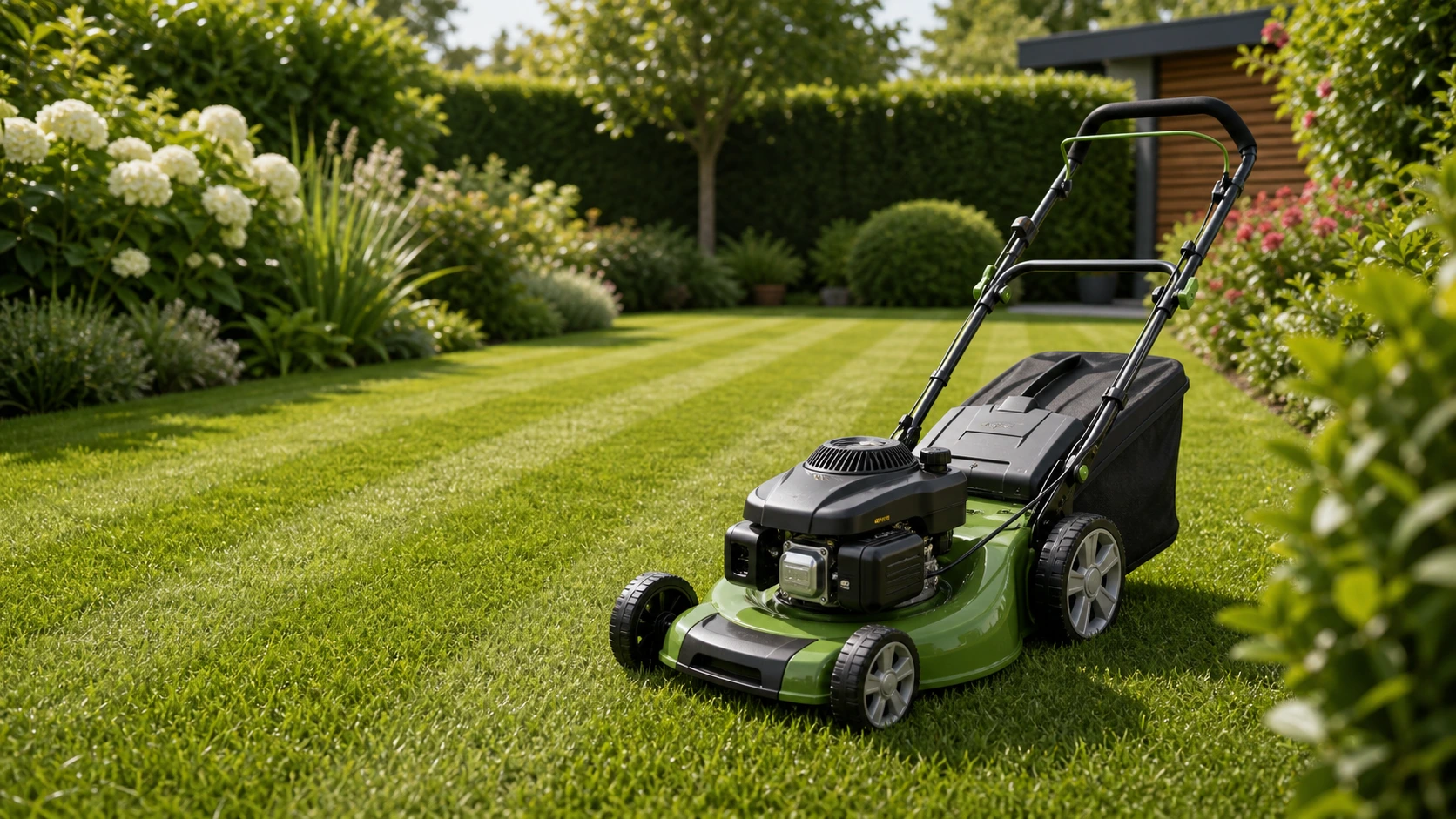
A robot mower does not cut like a conventional mower: it passes often and cuts little. That change of logic explains both the quality of lawn it produces and the disappointment of those who use it like a traditional mower. Here is how to choose the right model and get the installation right.
How a robot mower actually works
A robot does not collect the clippings. It mulches: it cuts a few millimetres at each pass and drops very fine fragments that break down and return their nitrogen to the soil. The result is a naturally fertilised lawn with no box to empty and no green waste to dispose of.
That method only works if the robot passes very frequently, several times a week and often daily. A robot going out once a week would end up cutting grass that is too long, which leaves visible clumps and tires the blades.
The corollary matters: a robot does not rescue a neglected lawn. You need to mow conventionally once before putting it into service.
- Permanent mulching, no collection and no green waste
- Frequent passes, often daily
- Does not rescue grass that is already long
With or without a boundary wire
Older models work with a boundary wire, buried or pegged to the ground, that physically delimits the mowing area. It is reliable and proven, but laying it takes time, and any change to the garden means repositioning the wire. A wire severed by a spade immobilises the robot.
Recent models dispense with the wire and locate themselves by satellite, generally with RTK correction from a reference antenna installed on the plot, sometimes supplemented by a camera or a LiDAR sensor. Boundaries are then set on a map from the app, and changed in seconds.
Wire-free models require in return a clear view of the sky for the antenna. A heavily wooded garden, or one hemmed in by high walls, can degrade reception, although dual-technology models compensate for those shaded areas increasingly well.
- Wire: proven, but slow to lay and awkward to modify
- Wire-free (RTK): zones redefined from the app
- Wire-free: needs a clear view of the sky for the antenna
Sizing for area and slope
The maximum area quoted by the manufacturer assumes ideal conditions: a single, flat plot of simple shape. Allow a margin of at least twenty per cent over your actual area.
Layout often matters more than surface area. A thousand square metres in one rectangle is far simpler to handle than six hundred split into several zones linked by narrow passages. Check the minimum corridor width the model can negotiate.
Slope is the most discriminating criterion, and the most often underestimated. It is expressed as a percentage: a model rated for 45 % climbs a gradient of roughly 24 degrees. Beyond its stated capability the robot spins, tears the turf and eventually reports an error. If your plot has pronounced cross-slopes, all-wheel drive becomes necessary.
All-wheel drive: useful or superfluous?
All-wheel drive powers all four wheels instead of two. On flat, even ground it brings nothing decisive and adds weight.
It becomes determining in three situations: pronounced slopes, ground that stays damp and slippery for much of the year, and uneven plots with roots, bumps or patches of bare earth.
If your garden is flat and well drained, save on that feature and invest instead in better run time or more precise navigation.
Safety, non-negotiable
Robot blades are mounted on a pivoting disc and retract on contact with a hard obstacle, which limits damage to both the machine and the obstacle. They remain perfectly sharp nonetheless.
Every robot should have a lift sensor and a tilt sensor that stop rotation instantly, along with an emergency stop button accessible on top. A PIN code prevents a stolen robot from being reused.
Despite those protections, never run the robot while young children are in the garden. Avoid mowing at night too: it is the leading cause of serious injury to hedgehogs, which freeze rather than flee. Schedule cycles during the day.
- Lift and tilt sensors are essential
- Accessible emergency stop and PIN code
- Never with young children present
- No night-time mowing, because of wildlife
Getting the installation right
The charging station should sit level, preferably in shade to preserve the battery, with several clear metres in front so the robot can align. It needs a protected outdoor power supply.
On a wired model, follow the boundary distances given in the manual scrupulously, as they differ depending on whether the edge is a wall, a border or a flush path. That is error number one, and it shows up as missed passes or a robot that oversteps.
On a wire-free model, take the time to map carefully and place the antenna at the most open point available, raised if necessary. Mapping done in haste translates into forgotten areas you will be finishing by hand all season.
Finally, allow a few days of adjustment: the first cycles always reveal an unforeseen obstacle, a misjudged slope or a passage that is too narrow.
Mowing frequency and cutting height
Let the robot work often. The logic of mulching is that it removes very little at each pass, which means going back over the same areas frequently.
On height, avoid cutting too short. Grass kept at around four to five centimetres resists drought far better, shades its own base and leaves less room for moss and weeds. A closely shorn lawn is more fragile and yellows at the first spell of heat.
During the spring growth surge, increase frequency rather than lowering the cutting height.
Maintenance and winter storage
Blades are consumables. Depending on the area and the nature of the ground, they need replacing once or several times a season. Blunt blades tear the grass instead of cutting it cleanly, which leaves tips that brown and increases battery consumption.
Clean the underside of the chassis regularly, where damp grass cakes up and eventually jams the cutting disc. A brush is enough, having cut the power and removed the battery if the model allows. Avoid a pressure washer, which drives water into the bearings and the electronics.
For winter, charge the battery fully before storage and keep the robot dry and frost-free. Bring the charging station in as well. Use the downtime to order next season blades.
- Blades replaced once or several times a season
- Chassis brushed regularly, never pressure-washed
- Battery fully charged before storage
- Robot and station stored dry and frost-free
What a robot does not replace
A robot mows, but it does not do the finishing. It always leaves an uncut strip along walls, fences and around fixed obstacles, because its blades do not reach the edge of the chassis.
Plan on an edge trimmer or brushcutter for a pass every two or three weeks. It is little work, but it is what separates an acceptable lawn from a tidy one.
The robot also does not deal with autumn leaves, or with fallen branches, which need clearing before you start a cycle to avoid jamming the cutting disc.
Frequently asked questions
Do I need a boundary wire for a robot mower?
Not necessarily any more. Recent models locate themselves by satellite with RTK correction, sometimes supplemented by a camera or LiDAR, and the mowing area is defined on a map from the app. The wire remains a proven solution but is slow to lay, and any change to the garden means repositioning it. Wire-free models do require a clear view of the sky for the reference antenna.
What area can a robot mower really handle?
The quoted area assumes a flat, single plot of simple shape. Allow a margin of at least twenty per cent over your actual area. Layout often matters more than surface: a garden split into several zones linked by narrow passages is far more demanding than one large rectangle.
At what slope do I need an all-wheel-drive robot?
All-wheel drive becomes necessary on pronounced slopes, ground that is often damp and slippery, and uneven plots with roots or bumps. Capability is expressed as a percentage: a model rated for 45 % climbs roughly 24 degrees. On flat, well-drained ground, all-wheel drive brings nothing decisive and adds weight.
Is a robot mower dangerous for children and pets?
The blades retract on contact with a hard obstacle, and robots have lift and tilt sensors that stop rotation instantly. Those protections are not enough: never run the robot while young children are in the garden. Avoid night-time mowing too, the leading cause of serious injury to hedgehogs, which freeze rather than flee.
What cutting height should I set?
Around four to five centimetres. Grass kept at that height resists drought far better, shades its own base and leaves less room for moss. A closely shorn lawn is more fragile and yellows at the first spell of heat. During the spring growth surge, increase the frequency of passes rather than lowering the height.
Does a robot mower do the edges?
No. A robot always leaves an uncut strip along walls, fences and fixed obstacles, because its blades do not reach the edge of the chassis. Plan on an edge trimmer or brushcutter every two or three weeks. Nor does the robot deal with fallen leaves or branches, which must be cleared before starting a cycle.
Ready to take the next step?
Browse our Robot Mowers selection